|
Trout Opinion - by Greg Betteridge
|
|
Algonquin Park is home to possibly the largest remaining aggregation of native (i.e. wild and unstocked) brook trout lakes in the world. This is something about which we can all be rightfully proud, whether we are anglers or not. The fact that they remain is evidence that we still care about our resources. The total number of brook trout that might be reproduced within a lake depends first, foremost and almost exclusively on the bottom surface area and flow rate of spring seepage within the lake. I’ve spent hundreds of hours in a drysuit exploring and searching for, filming and observing spawning brook trout, along with my friend Paul Blanchfield, who acquired both his Masters and doctorate on the subject. 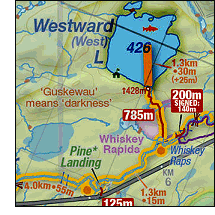
Westward Lake (65 hectares) in particular has a very small and limiting area of seepage and we estimated that there could never be more than 300 adult brook trout in the lake as a result. There are minnows by the millions as forage (averaging 700-900 dace per overnight minnow trap). However, baby brook trout in lakes emerge from redds (nests) excavated only where there are seeps from below. The logical answer to the ‘brook’ question is that virtually none of our explorations of streams flowing into lakes showed that spawning took place in them. Of course the larger park streams are suitable for reproduction and do hold brook trout. But there’s a big distinction between lake and river populations. As for the importance of springs (the fontinalis part of their name), Lake X (a sanctuary that is less than one twentieth the size of Dickson Lake) has a seepage area more than twice the size of that of Dickson and its productivity is incredible, with hundreds of brook trout competing to spawn. In Lake Y, the spawning area is equivalent in size to that of Dickson, yet the surface area is only 25 hectares versus Dickson's 1005 hectares. Both lakes produce just as many trout, but under vastly different conditions. It all boils down to the availability of suitable reproductive sites. Bass are prolific and can spawn virtually anywhere, yellow perch are scatter spawners, but the demanding requirements of brook trout have determined that they shall always be rare and threatened. The colouraton variabilities were explained to me by a friend and geneticist, who indicated that they are mostly morphs, just as both grey and black squirrels are the same species. . Even in Lavieille and Dickson lakes, the lake trout appear totally dissimilar .. lean/dark and fat/light, respectively. Trout generally get big by eating big things. In both Happy Isle and Louisa, the trout are almost without exception, small, ‘cookie cutter’ 1.25 to 1.75 pounds. However, I’ve seen lakers there weighing more than 20 pounds. But they’d turned cannibalistic, opting to eat the biggest available prey. 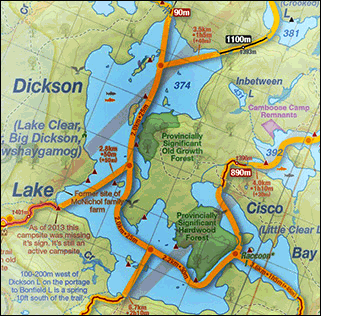
Proof positive that the brook trout population of Dickson Lake has suffered are my final visits to the primary spawning site. Mother Nature has created a wondrous sequence for brook trout spawning, whereby the largest females breed first, followed by smaller fish that don’t have the body mass to excavate fertilized eggs buried in redds (nests). From 2009 through 2012 (my last working years) we would seine-net females of all sizes and the numbers were historically (comparing back to 1962) lower than ever. It’s a lot more than algae involved, and since we’ve likely transitioned from the conservation to preservation stage, I can only hope that somehow these beautiful native trout might be saved. When it comes to fisheries science, I have a big problem with speculation, particularly as it concerns brook trout. Yellow perch are native to Dickson Lake and have long comprised the major spring-time diet item for brook trout there. Virtually every one of the hundreds of trout that I processed for anglers from 1979-82 contained them. In addition, perch are the primary food item for lake trout in Dickson. Yes, lake trout, in a lake that averages 7 metres in depth and has no measurable oxygen below 10 metres by late summer, are present in large numbers. Interestingly, in 2002 when MNR's fish culture section decided to 'rehabilitate' brook trout stocks in their hatchery system, they chose to promote the Dickson strain as a special 'perch eating' variety. This was even promulgated in a full page advertisement in a fishing newspaper. The underlying promise was that, if you had a problem with perch in your lake, here was a solution .. what I consider a somewhat deceptive representation. In addition, wild strains of brook trout (same species, different genetics) fare extremely poorly in hatcheries, where they are overcrowded, stressed by competition, subjected to conditions similar to those inflicted on chickens in commercial rearing facilities. Typically, wild brook trout yearlings are about one-third the size of domestic in-bred strains at stocking time. In hatcheries, their unique wildness has been nearly eradicated and I always compare situation to the rearing chickens in pens and then releasing them into the forest to compete with grouse. My mentor and supervisor, Jim Fraser, proved conclusively that wild trout in hatcheries fare best when raised only to the stage where they’ve absorbed their yolk sac (alevin or fry stage), at which point they could adapt extremely well in the wild. At that point, their inherent instincts kick in and they thrive. All of these instincts are beaten out of them in a fish farm environment. Logical and 100x more cost-effective to stock wild trout fry? Yes. However, the optics of stocking larger, ready-to-be-caught trout off the back of a truck are more high-profile. Accordingly, those promotional stickers telling about the efficacy of your Outdoors Card dollars at work are hard to argue against. |
Updated: March 16th, 2015